
Each staff member, and anyone in our online and physical spaces who uses our services or otherwise interacts with our office, must adhere to the applicable DePaul-wide regulations and procedures outlined by the Compliance Office, the University Policy and Procedures Office, the Undergraduate Student Handbook, and the Graduate Student Handbook.
To create a strong sense of community across our large and diverse staff, the Writing Center is transparent about our policies and procedures, and enforces them with fairness and consistency.
The standards and expectations that we have are derived from both the mission of our program and our role as a student support service within the Office of Academic Affairs and the larger DePaul University community.
On This Page
Our Obligation to Serve DePaul Students Workplace Expectations & ProtectionsShift Requirements & EtiquetteQuarterly Scheduling Process & PoliciesPaymentSick Time & Paid LeaveAttendance, Absence, Late Arrival, & Early Departure PoliciesYour First-Quarter Probationary PeriodProgressive DisciplineWriting Center Alcohol Information & PoliciesSummer & December Intersession HiringEnding Your Employment
Understanding the Writing Center’s following policies, procedures, and processes is a necessary part of working at the Writing Center. Please read through them in detail so you understand and are prepared for any situation relating to our internal policies that may arise.
Our Obligation to Serve DePaul Students
The Writing Center is a student support service entirely funded by student tuition and fees. We are part of the Office of Academic Affairs and the Office of the Provost.
Like other student support services such as academic advising, university counseling services, the library, and many others, all students—acting in accordance with DePaul’s Code of Conduct and not violating any of our Workplace Expectations and Protections (covered in the following section)—are entitled to Writing Center services by paying tuition and as such we ask that you work with any writer on any topic.
In addition to our institutional identity as part of the Office of Academic Affairs, the Office of the Provost, and the right to our services all students have as part of their tuition fees, your obligations derive from DePaul’s Guiding Principles for Speech and Expression at DePaul University.
🌎 All Students, Any Topic
- Tutors must work with every writer who makes an appointment with them.
- Tutors must make a good faith effort to treat every writer with kindness, respect, and professionalism.
- Tutors may not opt out of an appointment based on discomfort with the writer or their paper topic.
We only hold you to these obligations given the range of Workplace Expectations and Protections that, taken as a whole, allow each one of us to have a safe and healthy workplace and serve our mission to DePaul. If an appointment or any other communication between a writer and tutor involves a tutor being harassed or threatened or otherwise violates our Workplace Expectations and Protections, the writer will be reported to the appropriate DePaul office(s) so that the matter can be further investigated.
🚨
Consequences for Not Following Your Obligation to Work With Any Writer on Any Topic
Tutors who refuse to work with a writer or on a given paper will be subject to progressive discipline measures up to and including termination.
🗯️ Speech and Expression
The following comes from DePaul’s Speech & Expression Policies & Procedures; Guiding Principles for Speech and Expression at DePaul University, approved on May 26, 2017
📖
DePaul University's Mission is built upon the Vincentian ideal of universal dignity in which each person is invaluable and worthy of respect. That dignity depends in no small measure upon an individual's freedom and opportunity to give voice to their beliefs and on each individual's freedom and opportunity to choose whether and how to respond. DePaul therefore aspires to be a community marked by mutual respect and a community in which we never lose sight of the potential effects, both beneficial and harmful, of our words and of our expressive conduct. In this spirit, we affirm the following principles of speech and expression:
- We deem free and open expression as essential to intellectual inquiry. We affirm that, as a university, we have a responsibility to provide a setting in which a broad and diverse range of ideas can be exchanged civilly and respectfully.
- We affirm the right of members of the DePaul community to engage in speech and expression consistent with the values of academic freedom, free inquiry, and civil discourse.
- We affirm our responsibility to foster a respectful and inclusive learning environment. We recognize that part of DePaul's Mission is to continuously and actively amplify marginalized voices and to create opportunities for conversations that advance social justice.
- We affirm the right of individuals to express their viewpoints, even at the risk of controversy.
- We affirm the right of individuals to choose whether and how to respond to speech and expression. This may include responding with additional speech and expression, such as protests that respect the right of individuals to express their views.
- We affirm that the primary goal of speech and expression in a university context is to advance and enliven the intellectual life of the community. The University is committed to the principle that it may not restrict speech and expression simply because the ideas put forth are controversial. Rather, the role of the University is to create the conditions in which members of the University community have the opportunity to critically engage with a diversity of viewpoints. At the same time, we also recognize that speech and expression that serves only to threaten or intimidate does not further these goals.
- We affirm a presumption in favor of permitting speech and expression as essential to the pursuit of knowledge in the University setting. University policies and procedures will be interpreted and applied consistently with this presumption.
🧭 Navigating the "Contact Zone"
One theoretical/conceptual idea that informs our work is the idea that writing centers are by definition a “contact zone.” Given the range of courses and topics of study at DePaul, and the myriad backgrounds and identities of both our staff and the students and writers engaging in these courses and topics of study, any particular Writing Center appointment you're in can become a contact zone—“social space(s) where cultures meet, clash, and grapple with each other, often in contexts of highly asymmetrical relations of power, such as colonialism, slavery, or their aftermaths as they are lived out in many parts of the world today” (Pratt, 1991, p. 34).
Negotiating differences in a contact zone can, we know from experience, bring "rage, incomprehension, and pain"; it can also involve "exhilarating moments of wonder and revelation, mutual understanding, and new wisdom—the joys of the contact zone" (Pratt, 1991, p. 39 ). It is Important to understand that while they may include some discomfort or disagreement, these situations are educational and necessary in a college environment.
As a tutor, we ask that you have a willingness to productively navigate the contact zones in which you find yourself, and we are committed to providing you with training and strategies for doing so. And not only are we committed to providing such training, but our request that you navigate the contact zone in your work with writers is only ethical given the Workplace Expectations and Protections that exist to make sure your rights are protected while you're working at the Writing Center.
Arts of the Contact Zone
Representing and Negotiating Differences in the Contact Zone
Workplace Expectations & Protections
Workplace expectations & protections create a workplace for you that is reasonable and fair.
As administrators, we want to be transparent and equitable about the expectations we have for staff members and for each of you to understand the protections you have as a student employee. This handbook includes specific and detailed expectations, policies, and protections; Tutor protections, what you can expect from Writing Center administrators, and general workplace expectations (including the broader DePaul community expectations) are laid out in this section. Our expectations of you, as our tutors, are laid out in Shift Requirements and Etiquette.
🗣
Tutor Protections
- You have the right to a workplace free from harassment or discrimination
- You have the right to work with the Office of Student Employment and/or DePaul Human Resources to request reasonable accommodations based on the Americans with Disabilities Act
- You have the right to terminate employment at any time and for any reason
- You will receive timely notification of any disciplinary action—using the deliberate and explicit progressive discipline process outlined by the DePaul Office of Student Employment—or any other information related to your position at the Writing Center
- Administrators will be fair and timely in providing feedback
- Administrators will work to create a culture where everyone is guided by empathy and respect in resolving any issues that may arise during the course of your shifts
- You can contact administrators about any issue you have related to your work
- When you are assigned work beyond peer tutoring appointments (such as Tabling, Office Cleaning, Tutor Talk, or Mentor Check-ins), you will receive clear guidelines and support for accomplishing and meeting expectations
🗣
What you can expect from Writing Center administrators
- Writing Center administrators will be fair and timely in providing feedback.
- Writing Center administrators will work to create a culture where everyone is guided by love and respect in resolving any issues that may arise during the course of your shifts.
- You will receive timely notification of any disciplinary action—using the deliberate and explicit Progressive Discipline process outlined by the DePaul Office of Student Employment—or any other information related to your position at the Writing Center.
- You can contact Writing Center administrators about any issue you have related to your work at the Writing Center—at any time, for any reason.
- When you are assigned work beyond scheduled tutoring appointments, you will receive clear guidelines and support for accomplishing and meeting expectations.
🙊 Expectations of Behavior
In an effort to provide a healthy and safe environment for everyone who uses our services or enters our physical and virtual spaces—staff, writers, instructors, etc.—we expect anyone using our services and interacting with our student employees and staff members to refrain from unacceptable behaviors that violate DePaul's Code of Conduct, Code of Student Responsibility, Anti-Discrimination & Anti-Harassment Policy & Procedures, Student Handbooks, and other relevant University Policies and those that pose a threat to the rights or safety of other writers, students, instructors, or staff.
Unacceptable Behaviors
We consider unacceptable behaviors that unnecessarily impair the efficient and effective delivery of high-quality writing support—including but not limited to:
- Committing malicious or aggressive verbal communications or actions
- Exhibiting inappropriate physical contact with, or sexual harassment of others
- Using intimidating, threatening, vulgar, demeaning, disrespectful, discourteous, and/or abusive language and/or behaviors toward, or in the presence of writers, visitors, employees, and /or tutors
- Possession of firearms or any weapon
- Physical assault, arson, or inflicting bodily harm
- Intentionally damaging equipment or property
- Raising voice to the level of disrupting others or interfering with office procedures
- Racial or cultural slurs or other derogatory remarks associated with, but not limited to, race, language, or sexuality
If you are subjected to any of these behaviors or witness inappropriate behavior, please report to any administrator or student manager.
Violators are subject to removal from the office or online appointments and/or, pending a review of appropriate behavior with an administrator, suspension of their account. Any violations of the Code of Conduct or Code of Student Responsibility will be reported using the processes described in these Codes and, for DePaul students, the Student Conduct Process.
❌ Anti-Discrimination & Harassment
Anyone in the DePaul University community, including any Writing Center student employee or staff member, is affected by the Anti-Discrimination & Anti-Harassment Policy & Procedures, which protect each of us from discrimination, harassment, and retaliation, and detail the various procedures for reporting violations of this policy. See the full policy for details, related policy, and reporting procedures.
It is the policy of DePaul University that no person shall be the object of discrimination or harassment on the basis of race, color, ethnicity, religion, sex, gender, gender identity, sexual orientation, national origin, age, marital status, pregnancy, parental status, family relationship status, physical or mental disability, military status, genetic information or other status protected by local, state, or federal law in its employment or its educational settings. DePaul University reserves the right to take actions that are consistent with its policies and procedures to deal with individuals found to have engaged in harassment, discrimination, and/or retaliation in violation of this policy.
📜 Title IX
As a student employee of the Writing Center, you are protected and bound by DePaul's Formal Title IX Sexual Harassment Policy & Procedures and Sexual & Relationship Violence Prevention & Response.
DePaul University is committed to providing an environment that is free from all forms of discrimination and harassment, including sexual and relationship violence. Every member of the DePaul university community has the right to safety from the threat of sexual and relationship violence.
📣 How to Report
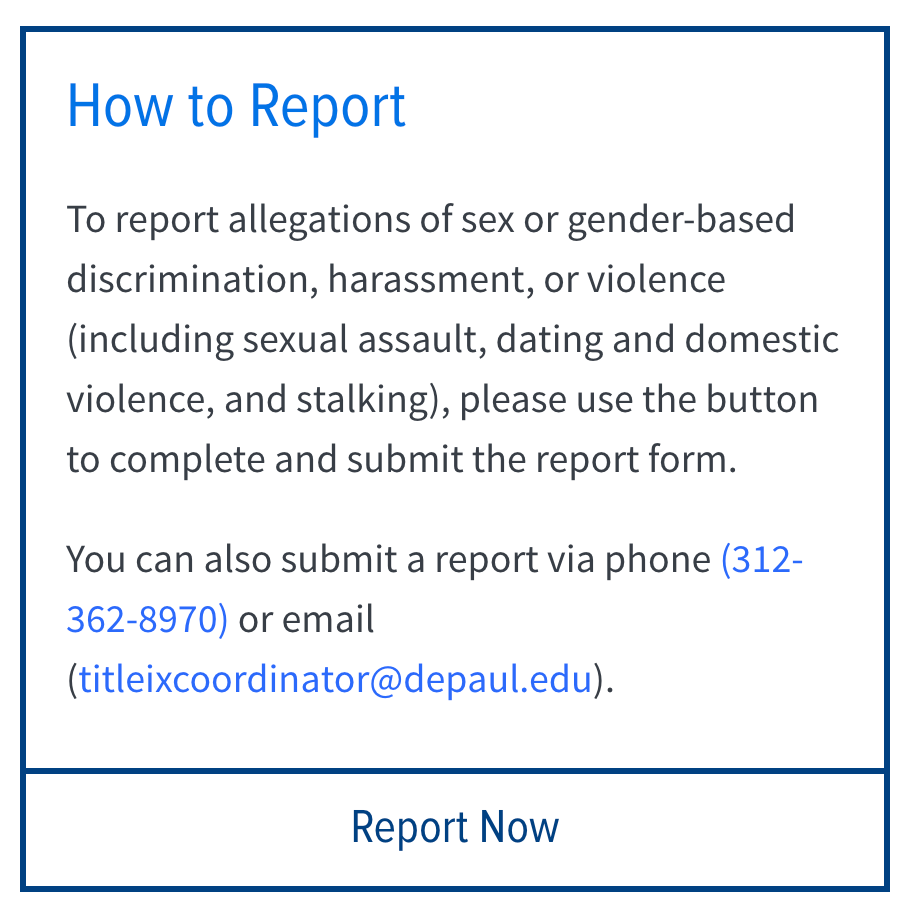
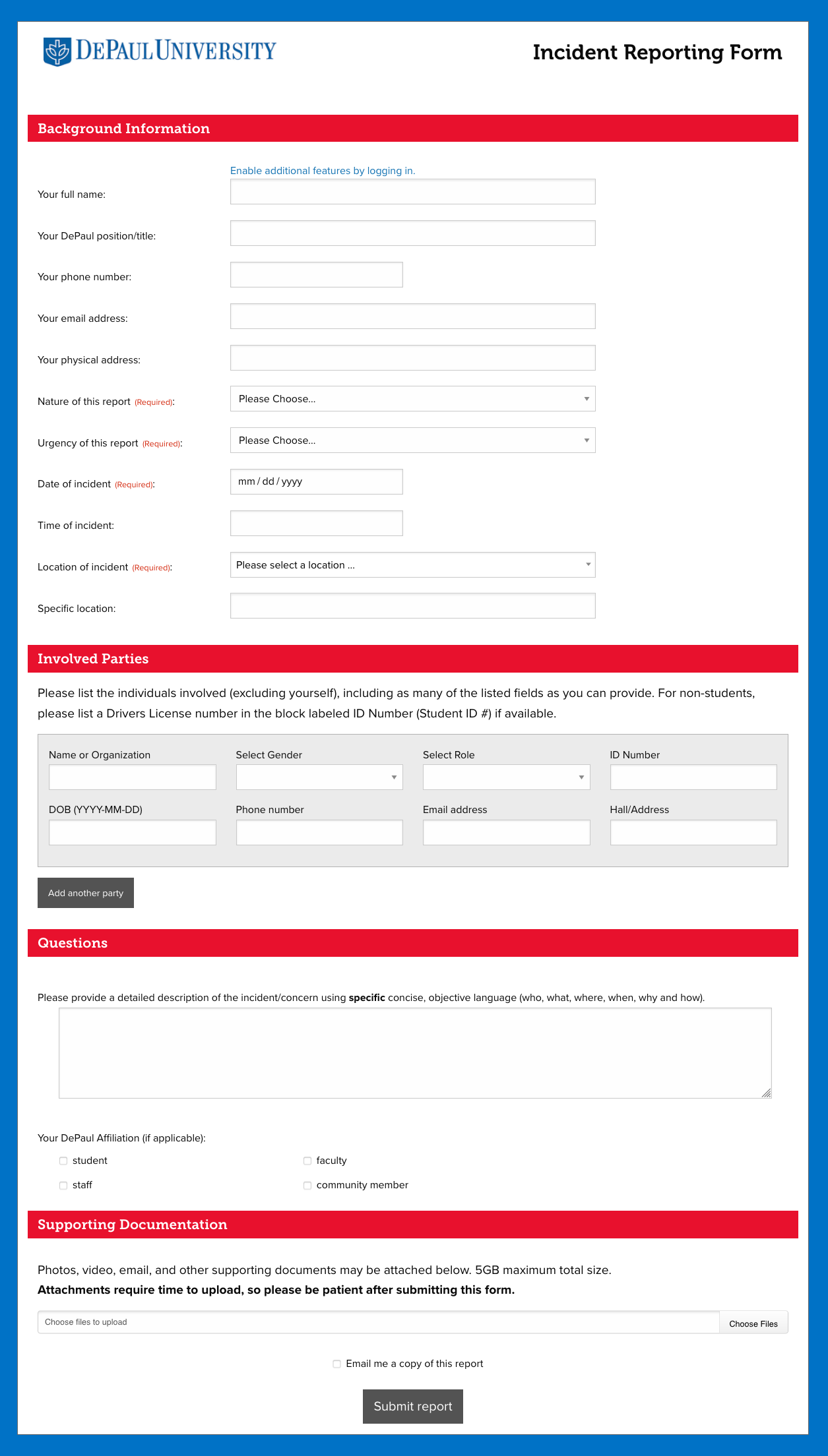
To report allegations of sex or gender-based discrimination, harassment, or violence (including sexual assault, dating and domestic violence, and stalking) that take place during your work at the Writing Center, contact Katie Brown via Slack or, if you prefer for any reason to do this on your own, you can submit a report yourself.
You can also submit a report via phone (312-362-8970) or email (titleixcoordinator@depaul.edu).
♿ Accommodation Policy
If you have an identified medical condition or disability that affects your ability to perform any of the essential functions of your job as outlined in A Tutor’s Obligations, the Peer Writing Tutor job description, or any Student Leadership position you have, we will absolutely work with you to make reasonable accommodations.
Page 3 of DePaul's Accommodation Policy; Disability and Pregnancy describes how any student employee (or full- or part-time employee) can make a "Disability Request":
If an employee has identified a medical condition/disability that affects his or her ability to perform the essential functions of the job he or she should begin the interactive process by completing the disability employee accommodation request form and sending it to employeerelations@depaul.edu.
Upon receiving notification from DePaul's Office of Human Resources, the Writing Center will work with HR to make any reasonable accommodation—defined as "modifications or adjustments to the work environment or the job application process necessary to enable a qualified individual with a disability to be considered for a position, to perform the essential functions of the job, or to enjoy equal benefits and privileges of employment"—that we can.
📣 How to Report Violations
Should you experience writers, co-workers, instructors, or anyone else violating the Code of Conduct or the Code of Responsibility during your work, Associate Director for Operations Management Katie Brown can help you report a violation, access resources, and otherwise offer you guidance and support.
Division of Student Affairs Instructions for Reporting Violations:
To report a possible violation of the code to the Dean of Students office (DOS) for further review and possible conduct action, please Report it now. These incident reports are for reporting non-critical or non-emergency incidents. If you have an emergency situation, please call 911 or Public Safety:
- Lincoln Park, 773-325-7777
- Loop, 312-362-8400
“Students may not engage in behavior that threatens or harms, or that may reasonably be expected to threaten or harm, other people. Students may not engage in behavior that is dangerous, destructive, or disorderly.”
“Conduct that may violate this policy includes, but is not limited to:
- Physically harming another person, either intentionally or by taking actions that create a substantial risk of physical harm to another person.
- Threatening to physically harm another person.
- Causing significant emotional harm through bullying or other means.
- Disrupting the peace.
- Impeding the business operations of the University.”
- Concerns related to student conduct are addressed through the Code of Student Responsibility, and the Student Conduct Process. Detailed information is available in the Academic Handbooks section of the University Catalog.
- Concerns about discrimination or harassment on the basis of a variety of protected characteristics are addressed by the Office of Institutional Diversity and Equity through the Anti-Discrimination and Anti-Harassment Policy and Procedures
- Concerns based on sexual violence, sexual harassment, or other sex discrimination (Title IX) are addressed through DePaul's Title IX Coordinator located in the Office of Institutional Diversity. Detailed information is available on the Office of Public Safety website or in the Code of Student Responsibility section of the University Catalog.
Shift Requirements & Etiquette
Making sure each one of us is thoughtful, deliberate, and focused on our work—and fair and considerate to one another—allows the Writing Center to achieve our mission to help writers and support rigorous writing and writing instruction at DePaul. As such, the following list includes many of the expectations Writing Center administrators have for each employee.
🗣
Tutor Expectations
- The Writing Center expects you to make helping people with their writing the primary focus of your work.
- We expect you to work with writers in all appointment modalities we offer.
- We expect you to work shifts at both our Lincoln Park and Loop locations. (During regular, in-person operation.)
- We expect you to be signed in and observing Slack and WConline at all points of your shift, whether you’re in-person or working Remote
- We expect you to be accountable for what you do and say during your shifts and in our spaces—virtual and physical.
- We expect you to show kindness and respect to everyone you interact with and be treated with kindness and respect yourself.
- We expect you to handle conflict with others—writers, your fellow staff members, administrators, etc.—with love and respect.
- After your initial onboarding and training quarter, each subsequent quarter you work as a Writing Center Tutor you may be assigned additional writing center roles—receptionist or writing group facilitator—based on program demands, schedule availability, and the number of hours you request.
- We expect all of our Tutors to be professional and do high-quality work.
📝 Things to Do Each Work Shift
- Upon arriving at work, say hello to the receptionist at the beginning of your shift.
- Throughout your shift, maintain open communication with the receptionist about your appointments and receive any feedback they may provide you.
- Inform the receptionist if you need to step away from Slack so that you can easily be located.
- Check WCOnline for your scheduled appointments and other work assignments and check it for updates throughout each shift.
- Check Slack for work-related information throughout each shift.
- Take any scheduled breaks when they are scheduled and return promptly afterward (if you are scheduled for a 5+ hour shift, the Student Managers will schedule you for a 30-minute paid break).
- If a problem develops that you cannot resolve, or if you are not sure how to handle a sensitive situation, discuss it with the Student Managers, administrators, or a receptionist as soon as possible so that it may be documented and resolved in an effective, timely, and professional manner.
- Do not end your shift for the day until all of your obligations (appointment letters, assigned tasks, etc.) have been completed. If you have any questions about the work you need to complete, send a slack message to the receptionist before you end your shift for the day.
Be Focused On and Committed to Your Work with Writers
Give your full attention to every writer, in every appointment modality, and for every genre of writing. Show them respect by paying close attention to them and their writing for the duration of each appointment or, in face-to-face or online real-time appointments, until they indicate they are ready to be done. If you find you and the writer have covered all the agenda items you set in a given synchronous appointment and you still have time remaining in their appointment, ask them if they have any further questions or any other writing projects they would like to discuss.
Similarly, unless you’re scheduled for non-peer tutoring work during a shift—like, for example, attending Tutor Talk or completing a deadline-sensitive and critical project—you should be ready to work with a writer at any point. If a writer cancels an appointment and you find yourself with unscheduled time you should still be prepared to work with a writer in the event one walks in. The receptionist may ask you to take a walk-in appointment even if it is not at a standard appointment start time.
🚨
Be Conscious of Your Conversations
Sometimes there are situations where you will be tempted to chat with your fellow Writing Center Tutors about an appointment that recently happened or an instructor that you just worked with. Be extremely cognizant of the environment you are in at that moment. Avoid public conversation about any student, writer, instructor, tutor, or other University employee where you can be overheard. Writers who hear peer writing tutors discussing other writers may worry that they are also being discussed after they leave the Writing Center. If you need to have a conversation to express some emotions, please be conscious of the space you are talking in within the office.
🤸 While at Work, Work
Working as a writing tutor is almost always your primary responsibility during a shift, but there will also be times when you will not have appointments with writers.
If you find yourself without an appointment with a writer
- Check your schedule to see if you’ve been assigned work by an administrator, coordinator, team leader, receptionist, or another Writing Center student leader
- Use your time to work on your Tutoring Reflections ePortfolio, quarterly SMART goal, write a blog post, read a style manual, look over a resource a colleague posted to the #resources Slack channel (or post a favorite writing resource there yourself), or find other things to do that help you improve as a peer writing tutor and make you better able to effectively do your work at the Writing Center.
🚨
Bottom line: try to do Writing Center-related work when the Writing Center is paying you to work.
💁 Office Etiquette
- Be sure to keep the Writing Center’s shared spaces clean and orderly. Clean up after yourself, push in your chairs, keep personal items in designated storage areas, and return Writing Center resources to where you found them. Sometimes you will have placeholders in your schedule to contribute to keeping our spaces clean.
- Ensure that conversations with your fellow Writing Center Tutors do not interfere—whether through volume or content—with other appointments or Writing Center work.
- Reserve personal calls for before or after your work shift. If you must conduct a personal phone call, do so between appointments. Step away from the tutoring area, inform a receptionist about your whereabouts, and keep the call as short as possible.
- Ask permission prior to using administrators' offices.
- Label food that you leave in the break room refrigerator with the date and your name. Remove food within 1 week of storing it.
- Reserve private Writing Center spaces such as break rooms and offices for Writing Center staff only. We love your friends, but they are not invited into staff-only spaces.
- Silence electronic devices while in the Writing Center.
- Return Writing Center computers to charging stations and plug them in when not in use.
🏠 Working From Home
Student employees have the option of working remotely/working from home for around 40% percent of their overall hours. The shifts will be the same as in-office shifts, with the exception that you will not be available for face-to-face appointments.
In order to have any work-from-home/remote work shifts—and so that you can conduct your work effectively—you need to agree to the following requirements:
- You have successfully completed your first-quarter probationary period
- You have a computer that is available and fully functional (including a functioning webcam) for each shift
- You have a working and reliable wifi connection for the duration of each remote shift
- You have a reasonably private and quiet space from which to remotely conduct appointments
- You are willing to frequently communicate with the receptionist via Slack to check in to your shift, to confirm receipt of any appointment documents, and prior to signing off from Slack at the end of your shift
🚨
You will forfeit the option to work shifts remotely if you do not adhere to these guidelines
Quarterly Scheduling Process & Policies
Prior to the beginning of each quarter, the Student Managers will solicit your availability and create your regular, consistent weekly schedule for the quarter, beginning week 2 and ending week 10 of Autumn, Winter, and Spring Quarters (with the exception of s, as your stipend pays you to work week 1-week 10 of each quarter).
⌛ Quarterly Time Commitment
We understand that each Writing Center employee has varying obligations, and we also strongly believe that you should prioritize your responsibilities as a student.
So we can foster a positive, consistent experience for both writers and your fellow Writing Center employees, be realistic about your responsibilities outside the Writing Center—your classes, other jobs, etc.—when you complete your availability survey each quarter.
Given that you are a student employee and your class schedule is unique every quarter, so too is your Writing Center schedule.
For each quarter you work, you set the number of hours you work each week and the days and times you work that quarter, by completing the scheduling availability survey and by confirming and/or revising that in consultation with the OSMs.
🚨
- New Writing Center Tutors work between 5 -10 hours per week during their first quarter
- Returning Writing Center Tutors work between 5-20 hours per week
- s work 14 hours per week, beginning week 1 of each quarter

Should you find you’re having a challenge with your schedule and balancing other commitments you have, we can help you!
Be proactive. Use the Schedule Change Request Workflow to request ways to make your schedule work for you. If you’d like to discuss this in more depth, contact Katie Brown who can help you find a schedule that works for you.
🏋️ Multiple Campus Jobs
If you work in another department at DePaul, you are responsible for abiding by University and federal regulations that limit working hours per week.
Student employees’ total work hours are limited:
- no more than 25 hours per week for domestic students
- no more than 20 hours per week for international students
🧮 Extra Hours
Your quarterly Writing Center schedule will never be more than 20 hours per week. Sometimes extra hours might be available—to meet tutoring demand or to help with an event.
If you work extra hours for us, you are responsible for abiding by University and federal regulations that limit working hours per week—either 25 hours per week if you are a domestic student or 20 hours per week if you are an international student.
Payment
Before you can begin working at the Writing Center, you must work with the Writing Center’s Associate Director for Operations Management and the Office of Student Employment to complete all DePaul-mandated and federally mandated hiring forms and processes. You cannot legally work at the Writing Center until DePaul’s hiring offices have completed the hiring process.
After this process is complete, you will be entered into the University’s payroll system. DePaul pays its employees on Fridays on a biweekly schedule.
🚨
Direct all questions about payroll to the Writing Center’s Associate Director for Operations Management, Katie Brown.
All undergraduate and graduate student Writing Center employees are paid hourly for any time that they work. You are responsible for entering these hours into your BlueSky timesheets and providing comments that detail your activities during that time.
You are also required to attend and enter hours for the following activities:
- Autumn Quarter All-staff Orientation
- Winter Retreat
- Any assigned required professional development activities or workshops, including Tutor Talk
All other Writing Center-related activities that occur outside of your normally scheduled shift must be approved by an administrator.
Each Writing Center employee will work between 5 and 20 hours per week. DePaul student employees are limited to 25 hours per week across all of their campus positions, so keep that in mind when deciding how many hours you wish to work. International student employees are limited to 20 hours per work.
📊 Pay Rates
All student employees begin work at the same hourly pay rate and are paid that rate through the end of their first academic year.
Student employees who return for a second, third, or fourth year (and so on)—in a tutor OR student manager role—receive a $.25 per hour raise at the beginning of each academic year, in Autumn Quarter.
Here is a breakdown of the pay rate for each Writing Center position during the 2026-2027 academic year.
Pay Rate
2025-2026 | |
Tutor, 1st year of employment | $18.00 |
Tutor, 2nd year of employment | $18.25 |
Tutor, 3rd year of employment | $18.50 |
Tutor, 4th year of employment | $18.75 |
Tutor, 5th year of employment | $19.00 |
ㅤ | ㅤ |
Student Manager, 1st year in position | $19.00 |
Student Manager, 2nd year in position | $19.25 |
Student Manager, 3rd year in position | $19.50 |
Student Manager, 4th year in position | $19.75 |
After your first year of employment, any raises you are entitled to, given the pay rates breakdown, will begin and take effect in the next fiscal year (which, at DePaul, begin annually in July; see Budget Blueprint website for details (log in required)).
💵
Pay Rate & Raise Scenarios
- You begin work in Autumn Quarter of 2024 at the Undergraduate tutor, 1st year of employment rate; your “2nd year of employment” pay rate takes effect in Autumn Quarter 2025, during the first shifts you work AFTER July 1, 2025
- You begin work in Autumn Quarter of 2024 as a first-year Graduate Assistant; your stipend covers the majority of your work hours, but when you are are selected to work in Summer Session 2025, your raise for hourly pay at the Graduate Tutor, 2nd year of employment takes effect on July 1, 2025
Sick Time & Paid Leave
Effective July 1, 2024, all staff are eligible for paid sick leave and paid leave, accrued at a rate of 1 hour of sick leave and 1 hour of paid leave for every 35 hours worked.
🚨
Because Graduate Assistants are paid through a stipend, their Sick Leave process is slightly different.
- Fill out a Schedule Change Request like normal so the receptionist and SM's can plan for your absence.
- If you have Sick time accrued, record it in Bluesky on the appropriate timesheet
- You will have a dropdown for both “Paid Leave - Students,” “Paid Leave - Student Stipend Position,” and “Sick.” Use the “Sick” option as that’s the one that will have your accurate Sick hours accrued.
- If you have used all your Sick leave but need to be absent due to sickness anyway, you will simply leave the effected days blank on Bluesky.
If you take sick leave exceeding your accrued sick hours, you WILL NOT receive hourly pay for hours worked that week unless your total hours still exceed 14, at which point all additional hours will be paid your regular hourly rate.
In case of prolonged use of additional sick days beyond your accrued Paid Sick Leave, Katie B will coordinate with the GA to adjust their schedule in a way that works both for the tutors needs and fulfills the needs of the role.
You enter any accrued paid sick leave or paid leave you want to use on your timesheet.
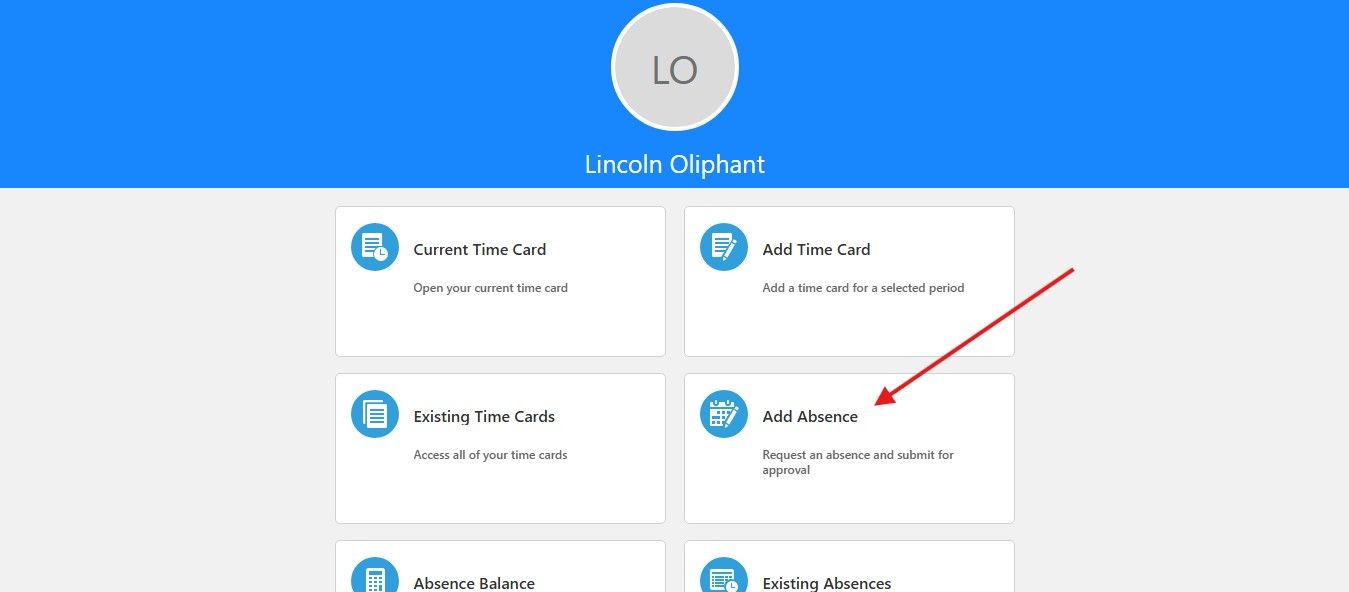
Navigate to the Add Absence tab in Bluesky (Found in Time and Absences, which you utilize each pay period to submit your time)
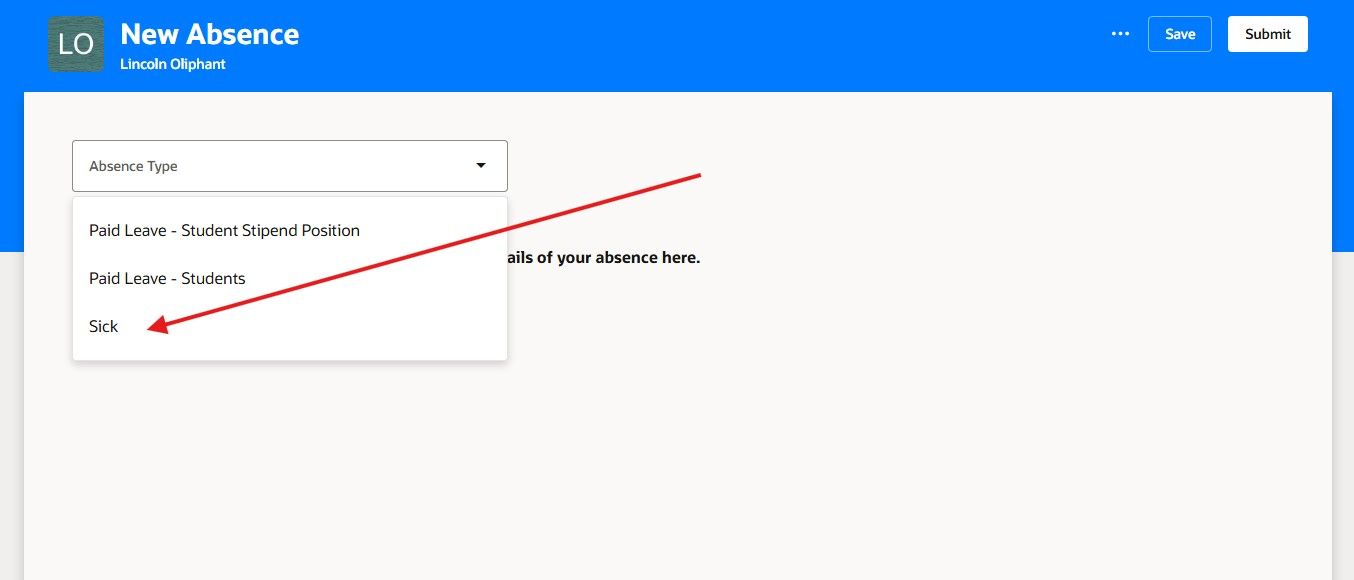
Select the Absence Type dropdown that reflects your needs (Most often it will be Sick.) then fill out the dates and times that will be effected.
🚨
Notice Lincoln has a dropdown titled “Paid Leave - Student Stipend Position.” This shows up for Graduate Assistants, but is unused by tutors, as the paid leave accrues on the “Paid Leave - Students” tab
From DePaul University Human Resources department on July 1, 2024:
Paid Sick Leave, which is covered under DePaul’s Sick Time, Short and Long-Term Disability policy, is intended to be used when you are sick or you are taking care of a sick family member.
Paid Leave, which is covered under a new Paid Leave policy, is intended to be used for any reason.
Highlights of the new and updated policies include (effective 7/1/24):
- For employees who already accrue sick time, they will accrue it at a rate of 1 hour for every 35 hours worked (formerly 40 hours worked).
- For all employees who don’t already accrue vacation, they will accrue paid leave at a rate of 1 hour for every 35 hours worked. Other details include:
- Up to 40 hours of paid leave can be accrued every year.
- Up to 16 hours of unused paid leave can be carried over at the end of the year.
- Upon termination, any unused paid leave will be paid out.
- If you haven’t had an active assignment at DePaul for 60 or more days, you may request a payment of any unused paid leave.
- Employees can start using paid leave on September 30, 2024.
DePaul’s HR Department Website with Details and FAQs About Paid Leave
Attendance, Absence, Late Arrival, & Early Departure Policies
Our attendance, absence, late arrival, and early departure policies make our expectations for you as an employee as clear as possible. These policies define certain standards of professionalism and help us maintain that professionalism across a wide range of individual staff members. These policies hold us all to a standard that maintains the integrity of our department.
If you are late to a shift or if you leave early without permission, be advised that the receptionist will inform Katie Brown, even for those infractions that only involve a matter of minutes.
We ask receptionists to report these late arrivals or early departures so that we can hold each tutor to the same standards and work with anyone who may need to have their regular work shift permanently changed to start or end later.
👔 Schedule-change policies
(revised as of 9/13/25; note added 2/6/26)
- You must be present for your entire shift
- You must check in and out with the receptionists
- You must complete Writing Center-related work during the hours for which you are paid
- Hours entered in your timesheet should reflect any late arrivals or early departures. For instance, if you leave work 15 minutes early during a 1-hour shift, your timesheet should reflect that you worked for 0.75 hours
- Tutors may request schedule changes in advance (with more than 72 hours prior to the shift starting) as needed
- Making 3 or more last-minute (within 72 hours of your shift) changes to your schedule in any given quarter will result in a meeting with Katie to discuss your schedule
- Excessive requests for shift changes (beyond 4 per quarter) may result in progressive discipline
- Missed shifts, late arrivals, and early departures cannot be made up, though administrators will occasionally use Slack to advertise opportunities for additional hours
Note: regardless of whether a schedule change is requested prior to or within the 72-hour window, tutors are not permitted to schedule make-up hours in the event that they need to miss a shift except in very rare exceptions. If you have questions about this policy, please contact Katie Brown.
Writing Center staff who do not adhere to these policies may be placed on progressive discipline.
🕟 What to Do: Absent or Late

Use the Schedule Request Workflow (found in the #schedule-change-request Slack channel) for ALL REQUESTS regarding your schedules—days off, long-term/permanent changes, etc. The Schedule Request Form streamlines the process for you and those making the changes.
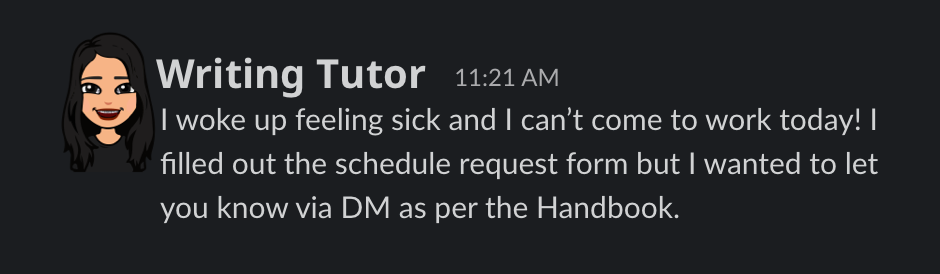
For any day-of changes, first submit a schedule request form and then DM the Admin on Call .
🤒 Short-Notice Absences or Running Late
Using the fastest and most reliable means possible—Slack is usually best—direct message the Admin on Call or any appropriate parties immediately to inform them of your situation.
If it isn’t possible for you to use Slack:
- call the Writing Center
- Loop: (312) 362-6726
- LPC: (773) 325-4272)
- or email writingcenter@depaul.edu
If your absence or late arrival occurs during or just before Writing Center business hours, message the Admin on Call AND the receptionist at the location at which your shift is scheduled, informing them that you will be absent or late so that they can begin working to remove you from the schedule.
At some point in this process—before or after you contact the Admin on Call and/or call/email the office, complete the Schedule Request Form (found in Slack) for that day’s absence or late arrival.
🔭 Anticipated Absences and Late Arrivals
When you plan to or anticipate being absent or late to a future shift, use the Schedule Request Form (found in Slack).
The further in advance of a planned or anticipated absence you can inform us about, the better. This allows us to reassign any appointments that you already have and block off your shift on WCOnline as soon as possible to prevent writers from scheduling appointments with you.
Your First-Quarter Probationary Period
In accordance with the policy of the DePaul Office of Student Employment, your first six months are an introductory/probationary period for employment.
To support this, we consider the first quarter you work as a tutor to be important to this probationary period, as this is when you receive critical training, both in the connected course and during your Writing Center hours. Your first-quarter probationary period allows you to get onboarded, learn how to work as a peer writing tutor, and become well acquainted with what is expected of you.
You must be in Good Standing at the end of your first quarter working at the Writing Center to continue working as a Writing Center tutor.
It is our hope that any and all new employees will have the necessary support and guidance to complete their probationary period in Good Standing.
New Writing Center staff members will be assigned a mentor—as part of the mentoring program—who will guide them through their first year at the Writing Center. This is a valuable resource that you can and should utilize when you have questions about what’s expected of you as a writing tutor.
🏅 Good Standing Requirements
- Receive a grade of "B" or higher in WRD 395 or WRD 582
- Show good faith evidence of adhering to the Writing Center’s
- Conduct the first of your with your assigned administrator
- Complete your first-quarter goal and appointment modalities reflection
🚨
💢 NOT Achieving Good Standing
If your performance is found to be inadequate, you are not passing or do not pass WRD 395 or WRD 582 with a “B” or higher, or if you are otherwise not found to be in good standing with the Writing Center, you may be let go at any time during this period without using the progressive discipline process. An administrator will contact you if you are not in good standing at the introductory period end date.
Progressive Discipline
All Writing Center employees are expected to perform their jobs with care, commitment, and professionalism. Writing Center administrators will ensure you have the mentoring, support, and ongoing feedback necessary to succeed within the Writing Center.
If you fail to adhere to the Writing Center’s standards and expectations for successful job performance after your first-Quarter probationary period, you may be subject to progressive discipline.
🚨
A tutor on progressive discipline cannot be on any internal Writing Center teams until they’ve returned to good standing.
📋 Where it Comes From
The Writing Center is bound by and uses the progressive discipline process outlined by the DePaul Office of Student Employment.
This process addresses an employee’s unsatisfactory performance by providing clear, documented communication between that staff member and an administrator that addresses the issue at hand and articulates clear, actionable steps they can take to improve performance.
The ultimate and ideal goal of progressive discipline is remediation and development, not punishment.
🚧 Behaviors & Violations
All of us are bound by existing DePaul University policies set forth by the Office of Compliance & Risk Management in the Code of Conduct. In addition to the policies in the Code of Conduct, student employees have specific responsibilities and rights that come with being a student at DePaul University, outlined in the Code of Student Responsibility.
Both the Code of Conduct and the Code of Student Responsibility define acceptable and unacceptable workplace and student behavior and make sure that everyone—in our physical and online spaces, using our services, or otherwise interacting with our office and our employees—has their rights and responsibilities defined and protected.
As a student support service within the Office of Academic Affairs, we use the procedures outlined in the Code of Conduct and the Code of Student Responsibility to address any violations of these codes of responsibility or conduct.
More specifically, the following behaviors may result in you being subject to the progressive discipline process:
- Chronic absences and/or tardiness, in excess of three in a quarter
- Unreported absence (no call, no show for a scheduled shift)
- Chronic failure to complete and/or send appointment letters by the end of your shift
- Defamation
- Serious offenses described by the Office of Human Resources, and in the Codes of Student Responsibility and the Depaul Code of Conduct
- Failure to complete work responsibilities as defined by your job description
- Recurring problems meeting or striving to meet quality of work standards
- Unprofessional behavior
- Failure to complete a quarterly ePortfolio or check-in meeting
- Abusive behavior
- Fraud
- Public discussion of confidential matters, especially when it would identify a particular writer
- Behavior that damages the reputation of The Writing Center
- Any other chronic negligence of responsibilities
- Chronic failure to check in with receptionists
- Chronic failure to check Slack during shifts
- Chronic failure to check WCOnline during shifts
- Chronic failure to complete or attend required professional development activities or workshops
This list is illustrative; it is not exhaustive.
Administrators may use their discretion to determine whether other behaviors not included here may warrant progressive discipline or termination.
🪜 Progressive Discipline Stages
Using progressive discipline consistently and clearly allows Writing Center administrators to address small issues with performance before they become habitual or increase in severity.
However, in rare cases of particularly egregious behavior, the Writing Center reserves the right to skip stages of progressive discipline and move to more severe consequences.
To protect your privacy, in the event that Progressive Discipline is needed, Katie B. will contact you individually to discuss necessary next steps.
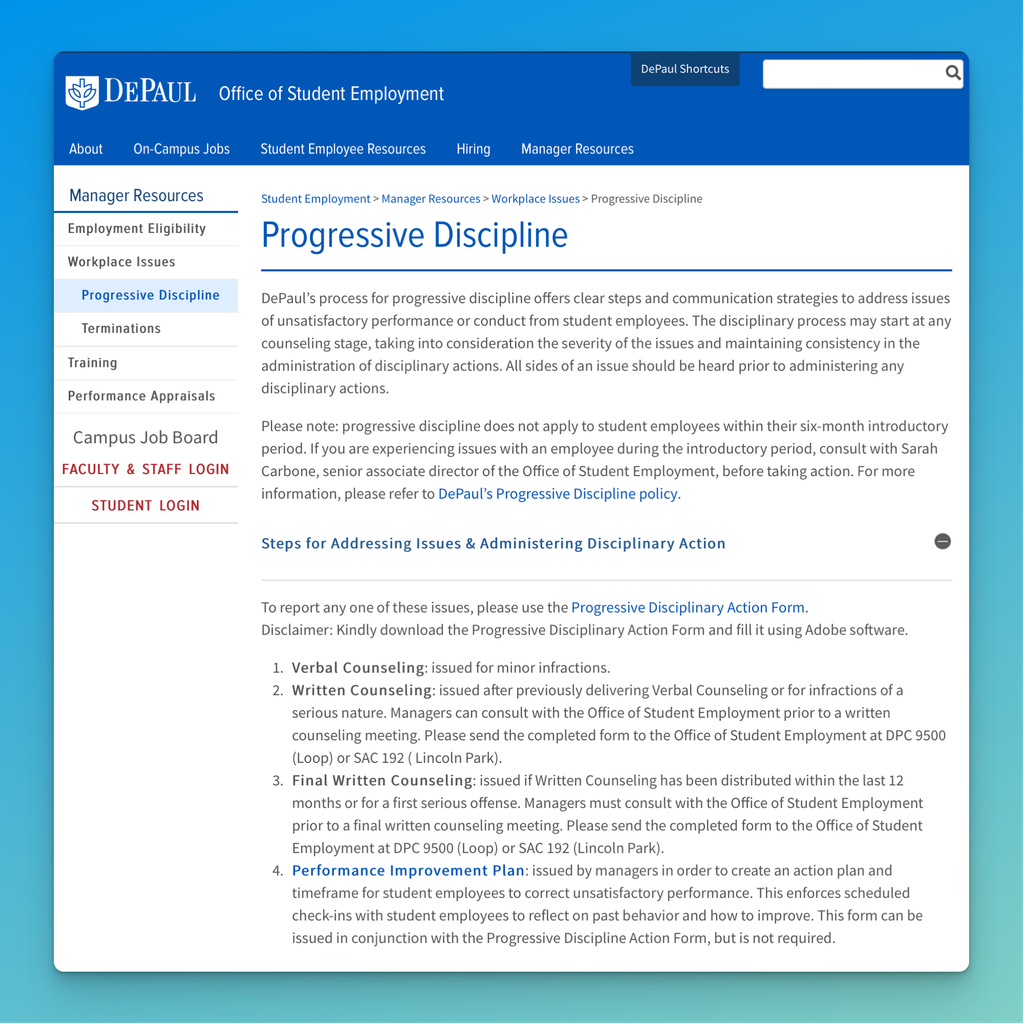
*Following list and forms taken from the Student Employment website
💻 *From Student Employment
Steps for Addressing Issues & Administering Disciplinary Action
- Verbal Counseling: issued for minor infractions.
- Written Counseling: issued after previously delivering Verbal Counseling or for infractions of a serious nature. Managers can consult with the Office of Student Employment prior to a written counseling meeting. Please send the completed form to the Office of Student Employment at DPC 9500 (Loop) or SAC 192 ( Lincoln Park).
- Final Written Counseling: issued if Written Counseling has been distributed within the last 12 months or for a first serious offense. Managers must consult with the Office of Student Employment prior to a final written counseling meeting. Please send the completed form to the Office of Student Employment at DPC 9500 (Loop) or SAC 192 (Lincoln Park).
- Performance Improvement Plan: issued by managers in order to create an action plan and timeframe for student employees to correct unsatisfactory performance. This enforces scheduled check-ins with student employees to reflect on past behavior and how to improve. This form can be issued in conjunction with the Progressive Discipline Action Form, but is not required.
Forms Used in Progressive Discipline
offices.depaul.edu
https://offices.depaul.edu/student-employment/hiring-managing/Documents/Progressive%20Disciplinary%20Action%20Form%20Ver%204.pdf
offices.depaul.edu
https://offices.depaul.edu/student-employment/hiring-managing/Documents/performance-improvement-plan.pdf
🚨
Involuntary Termination
If after both
- being placed on progressive discipline
- working with administrators to make an individualized performance improvement plan for continued work at the Writing Center
you fail to make necessary and agreed-upon changes to the appropriate extent, then you risk involuntary termination of employment.
If you commit an egregious offense in violation of any of our policies, we reserve the right to terminate your employment immediately.
Writing Center Alcohol Information & Policies
🥂 Alcohol Consumption
During certain Writing Center events, alcohol may be consumed legally and responsibly.
DePaul University has multiple policies in place regarding the consumption of alcohol on campus, including the Code of Student Responsibility, Alcohol Policy, Drug-Free Workplace and Legal Drinking Age Compliance, and Catering Services Exclusivity policy. At Writing Center events, it is the Writing Center’s responsibility to ensure compliance with these policies.
For any type of event, the event hosts are responsible for ensuring all DePaul University and Writing Center policies regarding alcohol are followed.
Events Only Open to Current Staff Members
If an event host has confirmed that a Writing Center coordinator or director will be physically present at an event to check IDs, current Writing Center Staff Members who are 21+ are permitted to bring and consume alcohol at Internal Writing Center events.
The Exception:
One exception to this rule is that attendees are not permitted to bring their own alcohol to any Writing Center event at which the Writing Center has ordered catering. Following DePaul University catering policies, events that offer catering may also order alcohol and the required bartending services package if alcohol will be served. The Writing Center will clearly announce for any staff-only events if alcohol will be provided by the Writing Center, and thus if bringing alcohol will not be permitted.
Examples of Internal Writing Center Events
- trivia night
- game night
- craft night
- “inreach” socials
Procedure for Event Hosts Hosting Internal Writing Center Events that may include Alcohol Consumption
- Confirm with the event coordinator or Writing Center Associate Director Erin Herrmann that the event is for current Writing Center staff members only and is not an exclusively-catered event.
- Ask a professional staff member (e.g a Writing Center administrator or coordinator) to be present and willing to check IDs at the event.
- Communicate to event attendees that those who are 21+ may bring and consume alcohol and will be required to show their valid, unexpired ID to the professional staff member upon arrival, in accordance with this Writing Center policy.
- Communicate to event attendees that responsible, respectful behavior related to the consumption of alcohol is expected in accordance with DePaul policies.
🚨
Policy Violation Protocol
If the Writing Center receives information that an event attendee’s conduct may violate the policies stated here and/or are in violation of the DePaul University policies linked above, the Writing Center will follow DePaul’s requirements for reporting conduct violations.
- DePaul students who violate policies may be subject to the Student Conduct Process
- Additionally, Writing Center staff members who violate policies will be subject to progressive discipline measures up to and including termination
In the event of an individual breaking the law by drinking underage, or in the event of an emergency at any type of Writing Center event, contact the DePaul Office of Public Safety. Emergency situations may include but are not limited to, someone drinking to excess, being disruptive, or becoming ill.
Summer & December Intersession Hiring
The Writing Center employs a smaller staff during DePaul’s Summer Session and December Intersession, given that enrollment in courses declines and there is less demand for appointments.
⚡ Priority Goes To:
The Writing Center uses Summer Session and December Intersession for program reflection, revision, and preparation. Thus, student employees in leadership positions are given priority in hiring:
- student managers
- student leaders and/or graduate assistants
Student employees in leadership roles are offered Summer and December positions first based on our budget and priorities.
🙋 Other Tutors
When budget and other considerations allow, tutors not in leadership roles may have the opportunity to work over the Summer and December Intersession as tutors, and by taking on special projects and leadership roles.
Administrators will announce any remaining available positions, after determining which student leaders will be working these periods, to all Writing Center staff. They will distribute instructions for applying prior to the start of the Summer Session or December Intersession.
Ending Your Employment
Your employment with the Writing Center will end in one of three ways:
- Your own voluntary resignation
- Your termination upon graduation
- Involuntary termination
👋 Voluntary Resignation
The Office of Student Employment outlines steps you should take to end your employment at the Writing Center, including notifying Katie Brown and sending a “recommended” letter of resignation, identifying your last active day of employment.
🧑🎓 Terminations Upon Graduation
As per the Student Employment website, we are responsible for terminating any student employee upon your graduation. You need not send us a resignation letter if your employment with us will end due to graduation. And congratulations on your graduation!
🚨
Involuntary Termination
If after both
- being placed on Progressive Discipline
- working with administrators to make an individualized performance improvement plan for continued work at the Writing Center
you fail to make necessary and agreed-upon changes to the appropriate extent, then you risk involuntary termination of employment.
If you commit an egregious offense in violation of policy, we reserve the right to terminate your employment immediately.