In the Writing Center, we seek to foster a growth mindset—the belief that we can enhance our skills through hard work, reflection, and collaboration—with our writers and with ourselves. We know from experience how helpful—and necessary—feedback on our work is in order to affirm our strengths, receive guidance on ways to improve, and connect our practices with our beliefs and values.
Completing a goal you define each quarter and reflecting on your work gives you time and space to develop insights into your own work and note areas of strength and areas where you’d like to learn more. Reflection is also an important part of developing metacognition: the ability to notice not only what you are doing in your tutoring practice, but why you are making particular choices. Taking time to regularly reflect can help you to identify the strategies, values, and assumptions shaping your work and to name the writing center pedagogy you are already practicing. This awareness supports your growth as a tutor and is highly transferable to other academic and professional contexts.
The tool you’ll use to prepare for your quarterly check-in—an ePortfolio—allows you and the administrators at the Writing Center to have concrete, tangible documentation of your work quarter-by-quarter while you work for us. As such, it helps administrators write specific letters of recommendation about you and provide detailed references for you after you successfully complete your employment at the Writing Center.
✅ Quarterly Check-ins
For each quarter you work for us, you will check in with an assigned administrator to discuss your ongoing professional development as a tutor and employee.
In advance of your check-in meeting with your assigned administrator, for each quarter you work for us—with the exception of your final quarter—you will prepare the items listed below in an ePortfolio based on a template we provide. You are strongly encouraged to proactively block off up to 1 hour per week (Weeks 2-8) in WCOnline to complete the requirements.
Goal Statement, Artifact, & Reflection
To support your individual and collective growth as tutors, you will set and work toward a SMART goal each quarter.
To help you take stock of your work as a Peer Writing Tutor by identifying the practices shaping your tutoring and noting opportunities for growth, we ask you to reflect each quarter on your appointments.
Reflection is more than looking back at whether an appointment went “well.” Writing studies scholar Kara Taczak (2015) describes reflection as a deliberate practice that helps us recognize what we are doing and consider why we make particular choices. Over time, this metacognitive awareness helps us “recall, reframe, and relocate” knowledge and practices across different contexts (p. 79). Because reflection is a skill that must itself be practiced, returning to it each quarter gives you repeated opportunities to notice how your tutoring is developing.
Your tutoring practices may become intuitive over time, so reflection offers us the opportunity to make the implicit explicit. This means slowing down to think through your choices and identify the pedagogy behind them. Asking a question, changing strategies, prioritizing one concern over another, or responding to a writer’s stated goals can reflect larger commitments to writer agency, collaboration, accessibility, responsiveness, or transfer.
👁️
Reflection helps make internalized knowledge visible: instead of only asking What did I do?, we can also ask Why did I make that choice? What tutoring value was I practicing? What might I carry into another appointment?
For an example of this process, visit the Writing Center’s blog UCWbLing to read “Wait, That Was Pedagogy?: Metacognitive Reflection & the Choices We Make as Tutors” by Cailey Scott.
Reference
Taczak, K. (2015). Reflection is critical for writers’ development. In L. Adler-Kassner & E. Wardle (Eds.), Naming what we know: Threshold concepts of writing studies (pp. 78–79). Utah State University Press.
Requirements for Reflection on Tutoring Practices
Each quarter, you complete 2 reflections on your tutoring practices:
1 synchronous reflection (F2F and/or ORT)
1 asynchronous reflection (written feedback)
For each reflection, choose one of two options: self-inquiry or self-observation. You may use the same option for both modalities or complete one of each.
If you have two or more appointments in a given modality in a given quarter, you may choose to complete a Self-Inquiry or a Self-Observation for that modality in your ePortfolio for that quarter.
If you have only one appointment in a given modality in a given quarter, you complete a Self-Observation on that one appointment for that modality.
In rare cases where you have no appointments in a given modality in a given quarter, you do not need to complete a reflection for that modality that quarter; you should document that fact on that modality’s page of your quarterly ePortfolio before submitting.
How to Create Your Quarterly Check-in ePortfolio
Each quarter, you will create a new ePortfolio to submit your quarterly goal and tutoring modality reflections. You will use an ePortfolio template created by the Writing Center to streamline this process.
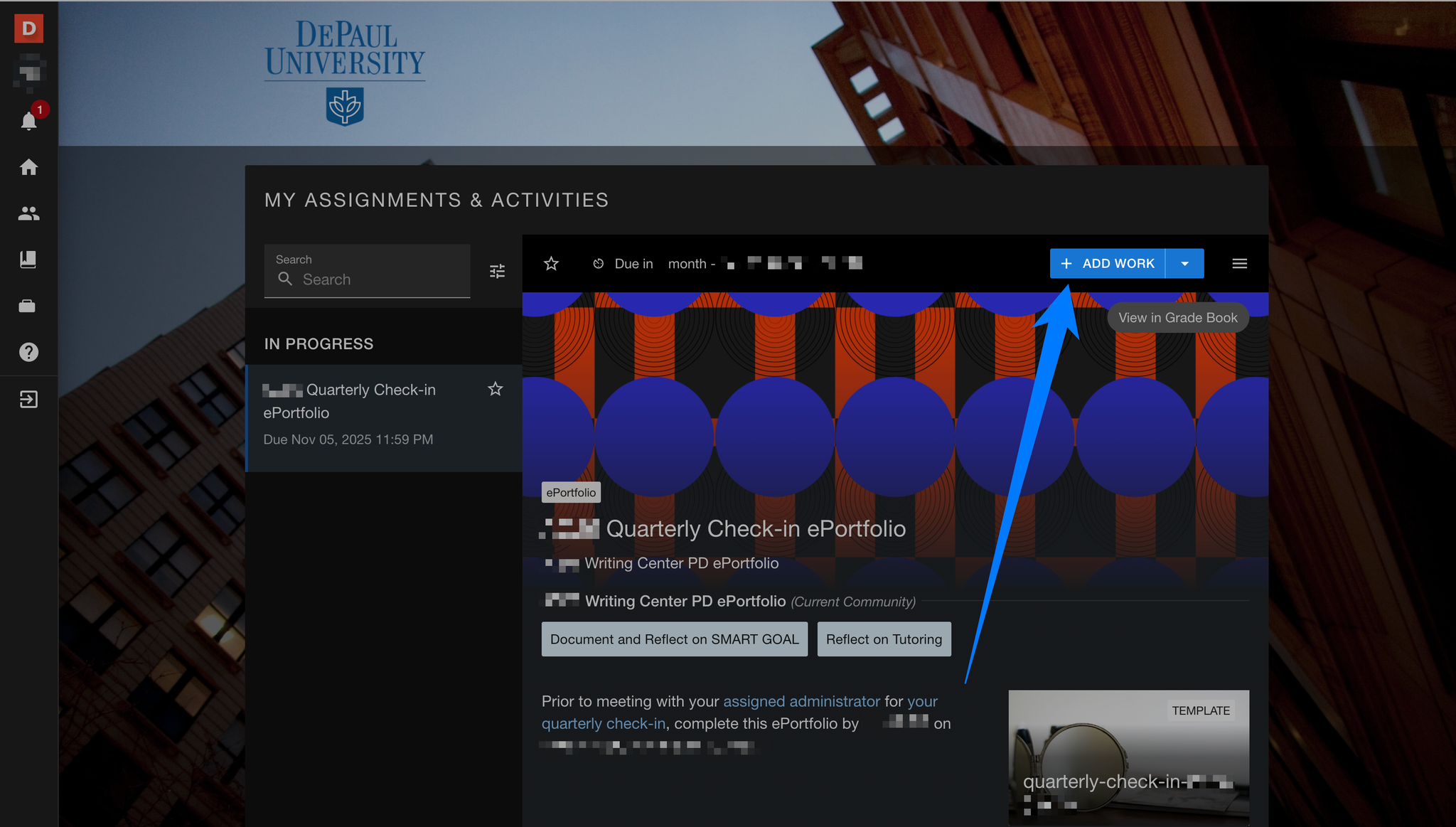
You’ll see “My Assignments & Activities” at the top of your home screen
You’ll be automatically enrolled by Writing Center administrators in a “Community” for the current quarter and the kind of ePortfolio you’re assigned for the current quarter (i.e., quarterly check-in or final quarterly check-in)
In this current-quarter Community, you’ll be assigned an Assignment for the current quarter ePortfolio
Select the + ADD WORK button to begin creating your ePortfolio
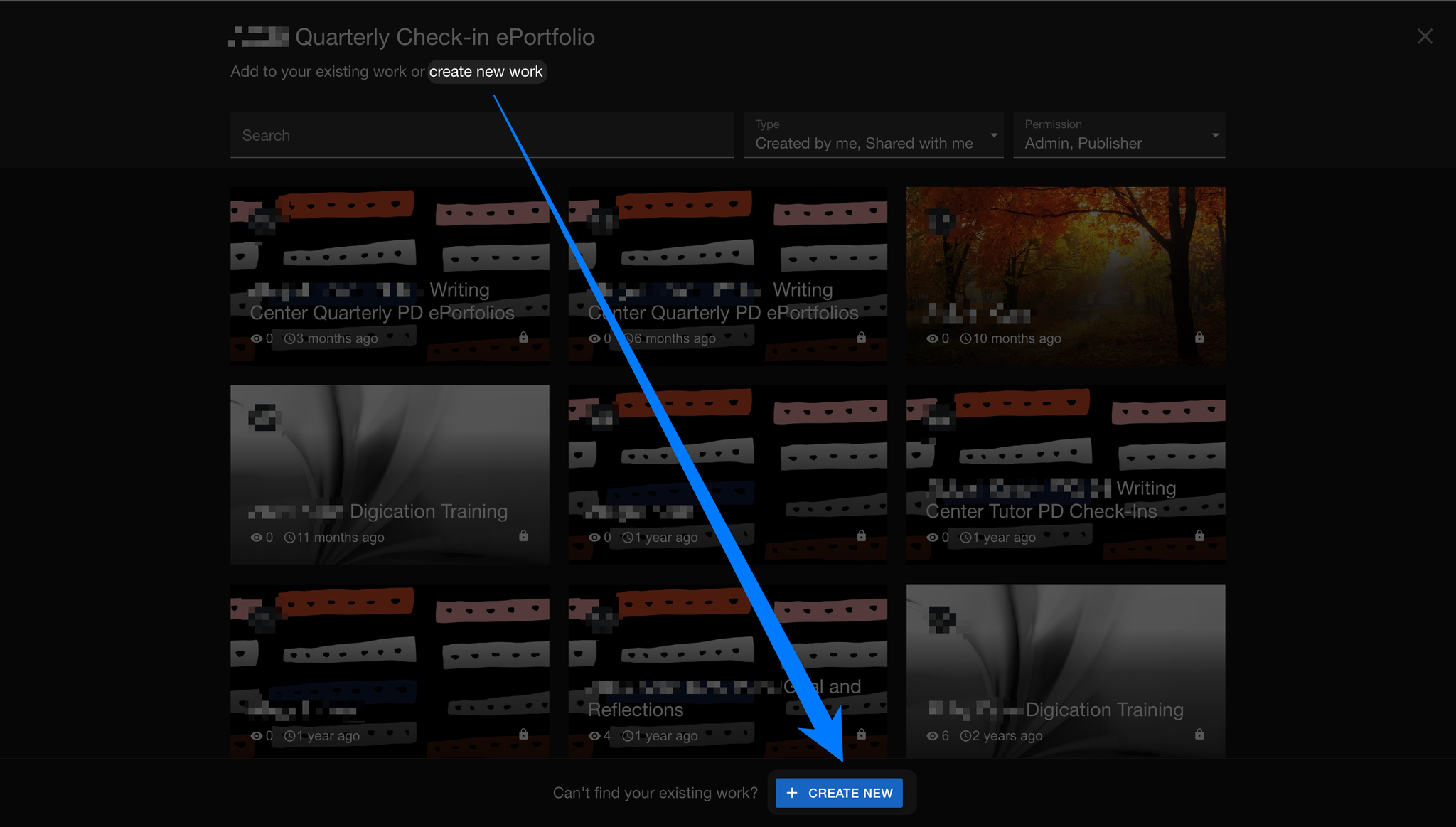
Digication will load a new page, giving you options for what “WORK” to add
You’ll see your “existing work” in Digication (past ePortfolios you’ve made) and the ability to create new work
Select the + CREATE NEW button
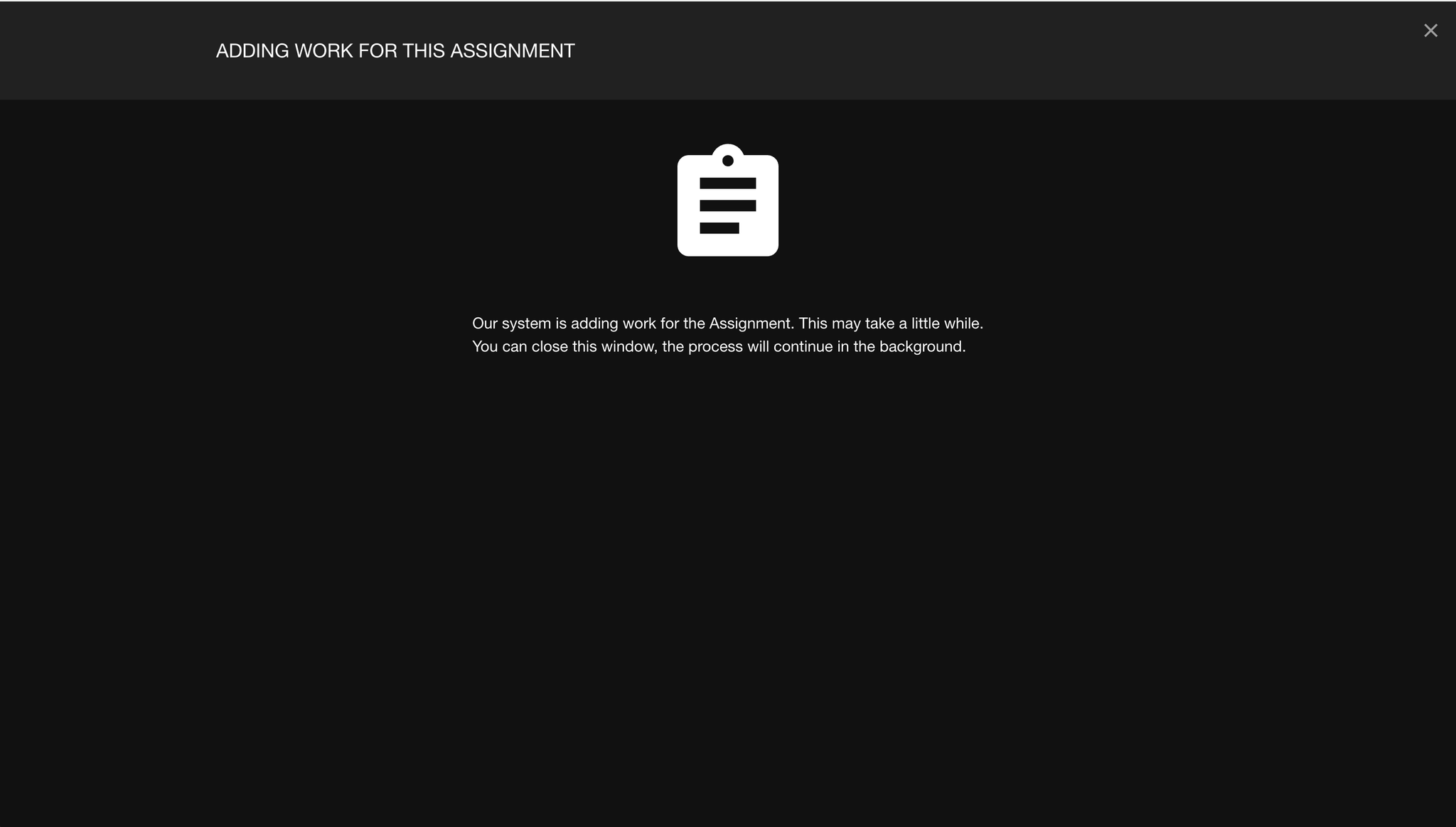
Digication will show you a screen indicating it is ADDING WORK FOR THIS ASSIGNMENT
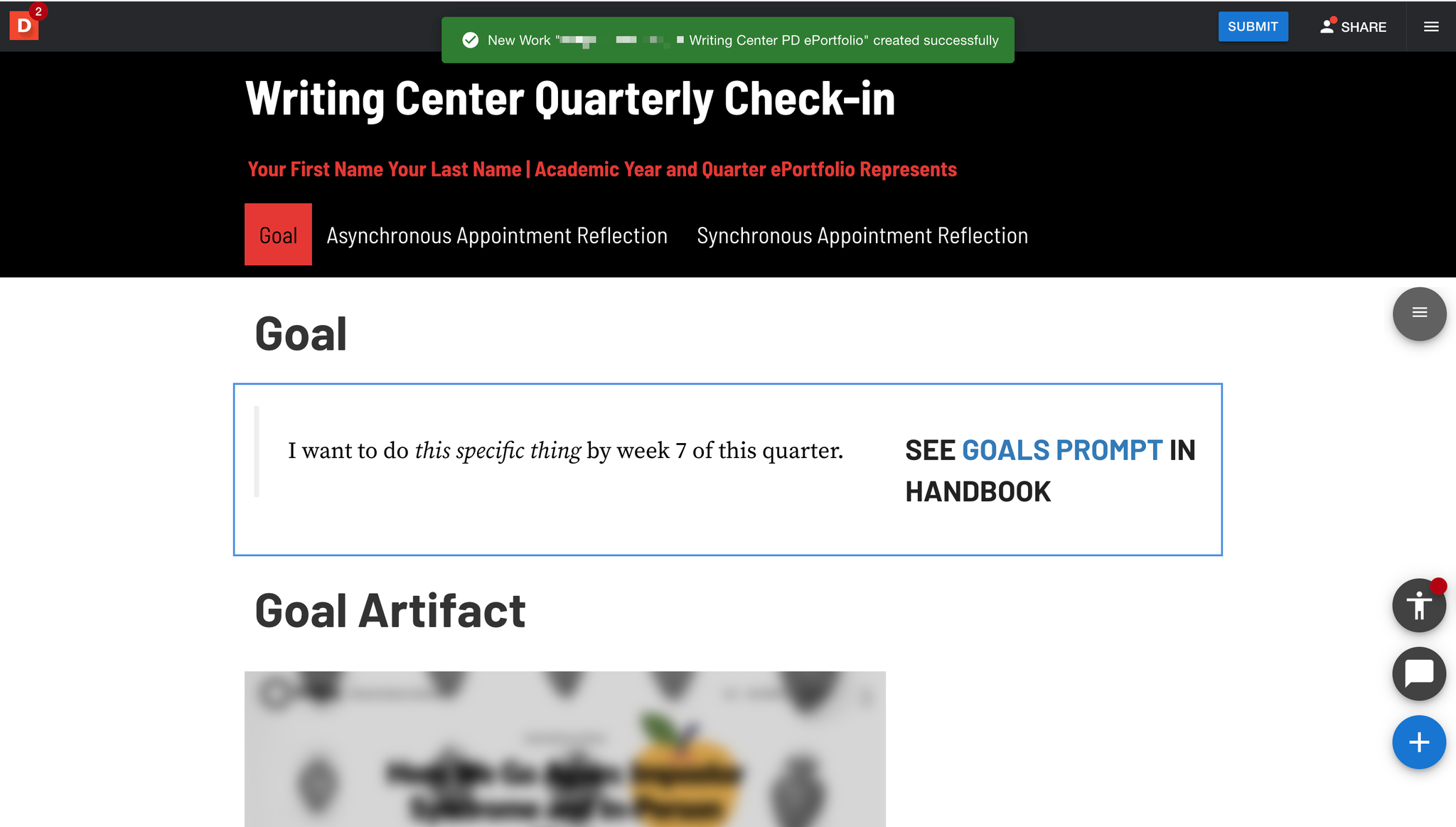
A new ePortfolio will be created with a template heading and subheading and three pages:
Goal
Asynchronous Appointment Reflection
Synchronous Appointment Reflection
Be sure to update the template subheading with your name and current quarter information (red text in the above screenshot) and complete the content on each of the three pages
🏁 Your Final Quarter
For your final quarter of employment at the Writing Center, you complete a quarterly SMART Goal as usual and you also include a holistic reflection letter on your experience at the Writing Center instead of reflections on tutoring practices. Identified based on the information you submit to the Writing Center regarding your employment plans, tutors completing their final quarter at the Writing Center will be invited to use a specific template in Digication that includes the following required elements:
It depends on how you’re using it. We ask that you do NOT use AI to compose the reflections in your ePortfolio.
As one of our Writing Center’s core values, reflection is important in all aspects of our work. Your ePortfolio invites you to reflect on your goal and on your tutoring (or, in your final quarter, on your overall Writing Center experience). These reflections allow you to engage in critical thinking about what you learned in the process of completing the goal or in tutoring. Such critical thinking supports deep learning as you name and internalize what you’ve learned.
You should compose your reflections without the use of generative AI in order to engage in the critical thinking and deep learning offered to you in creating your ePortfolio. Moreover, administrators value your voice as a writer and encourage you to write transparently and authentically based on your own thoughts, feelings, curiosities, and inquiries.
You may use AI in brainstorming for your goal and/or reflections. You may use Grammarly or other AI to review your writing (or consider scheduling a Writing Center appointment for feedback from a human!).
How do I create my ePortfolio?
You will use a template we provide in Digication.
Digication is DePaul’s official ePortfolio platform. In the Writing Center, you learn about ePortfolios or refresh yourself about the genre and platform/software for making ePortfolios (currently Digication) by completing Digication Training in Autumn Quarter.
Who will view my ePortfolio?
Because we want to encourage genuine reflection on your work and your goals, your ePortfolio is a private document that you share only with Writing Center administrators.
Can I make changes to the ePortfolio template?
Yes! You are welcome (but not required) to make any aesthetic changes that you would like—change colors or fonts, etc.
Can I edit my ePortfolio after I’ve submitted it?
You are allowed multiple submissions in Digication. While you cannot edit an existing submission, you can edit your ePortfolio and resubmit it. Each submission shows the date and time it was submitted, so your assigned admin will reivew the most recent submission.
What happens if I do not complete my ePortfolio & check-in meeting in a given quarter?
Because we believe deeply in the value of this process, failure to complete either part of quarterly check-in requirements—your ePortfolio and check-in meeting—will result in progressive discipline and you will be informed of this at the end of the quarter when it occurs. Repeated failures to complete check-ins may lead to termination of your employment.
If you are having difficulty completing the requirements, please get in touch with your assigned admin to keep communication open. We will work with you to make flexible arrangements to the extent possible.
What happens if I do not complete my ePortfolio & check-in meeting in my final quarter of employment at the Writing Center?
If you fail to complete either part of quarterly check-in requirements—your ePortfolio and check-in meeting—during your final quarter, you forfeit your eligibility for administrators to write you future letters of recommendation or serve as references on your behalf.
We strongly encourage you to complete your employment with us in good standing, so we are able to help you throughout your future professional and academic pursuits.
Can I get feedback on my work from an administrator outside of the quarterly check-in meetings?
Outside of the formal processes outlined here, any administrator is happy to meet with you to discuss any aspect(s) of your work on which you would like feedback. Contact any or all administrators via Slack to make an appointment to talk or DM or Zoom, etc.
📋 Quarterly Timeline
Autumn Quarter 2026
While all tutors submit ePortfolios and meet with your assigned admin on the same schedule, NEW and RETURNING tutors have differing due dates for submitting your SMART Goal in Autumn Quarter. Please see all due dates in the corresponding sections below.
RETURNING Tutors: Due Dates for Setting & Confirming Your AQ SMART Goal
Returning tutors set SMART goals as soon as the Writing Center opens in Autumn Quarter in order to maximize time in the quarter to complete your goal.
WEEK
DUE DATE
TASK
Week 2
Wednesday, 9/16/2026- Tuesday, 9/22/2026
Draft a SMART Goal. Ensure the timeline you set for your goal is achievable by the due date for submitting your completed ePortfolio by the end of Week 8 (see below for details).
Receive feedback on and suggested revisions of your SMART Goal from your assigned admin via Slack DM.
NEW Tutors: Due Dates for Setting & Confirming Your AQ SMART Goal
New tutors set SMART goals after a few weeks of onboarding into your work at the Writing Center so that you can understand more about your role and what you might like to work on for your goal. This extended timeline also ensures you have an opportunity to connect with your mentor about setting a SMART goal before your submit your goal draft to your assigned admin.
WEEK
DUE DATE
TASK
Weeks 3-4
Note: New tutors are scheduled to meet with their mentors during Week 4; that check-in will include time to discuss SMART goals!
Wednesday, 9/23/2026 - Tuesday, 10/6/2026
Draft a SMART Goal. Ensure the timeline you set for your goal is achievable by the due date for submitting your completed ePortfolio by the end of Week 8 (see below for details).
Receive feedback on and suggested revisions of your SMART Goal from your assigned admin via Slack DM.
Coordinate any revisions to your goal in communication with your assigned admin.
ALL Tutors: Due Dates for Submitting Your ePortfolio & Meeting with Your Assigned Admin
WEEK
DUE DATE
TASK
By end of Week 3
By Tuesday, 9/29/2026
Admins confirm tutors’ graduation plans to lock in accurate membership for quarterly Digication communities.
By end of Week 4
By Tuesday, 10/6/2026
Tutors added to appropriate community in Digication for the quarter.
Begin scheduling your quarterly check-in meeting with your assigned administrator. Admins will announce their availability and sign-up links on this date.
While you may schedule your meeting in advance, your ePortfolio must be submitted before your quarterly check-in meeting occurs and no later than the due date (see next row).
By beginning of Week 9
By 11:59 PM on Wednesday, 11/4/2026
Submit your completed ePortfolio to the specific/correct assignment in Digication (e.g., submit your winter quarter ePortfolio to the winter quarter assignment), including your
1. completed SMART Goal and
2. reflections on tutoring practices (for synchronous and asynchronous) in the form of Self-Inquiry and/or Self-Observation (or Final Reflection Letter when in your last quarter of work).
Week 9, Week 10, or Finals Week
Wednesday, 11/4/2026 - Tuesday, 11/24/2026
Meet with your assigned administrator to discuss the contents of your ePortfolio, your reflections, and your next steps.
Winter Quarter 2027 - in progress
WEEK
DUE DATE
TASK
Week 2
Monday, 1/12/2026 - Sunday, 1/18/2026
Draft a SMART Goal. Ensure the timeline you set for your goal is achievable by the due date for submitting your completed ePortfolio by the end of Week 8 (see below for details).
By end of Week 2
By Sunday, 1/18/2025
Admins confirm tutors’ graduation plans to lock in accurate membership for quarterly Digication communities.
By start of Week 3
(Note: Writing Center closed Monday, 1/19/2026 for MLK Jr. Day)
Tutors added to appropriate community in Digication for the quarter.
By start of Week 4
By Monday, 1/26/2026
Receive feedback on and suggested revisions of your SMART Goal from your assigned admin via Slack DM.
Coordinate any revisions to your goal in communication with your assigned admin.
Begin scheduling your quarterly check-in meeting with your assigned administrator. Admins will announce their availability and sign-up links by this date.
While you may schedule your meeting in advance, your ePortfolio must be submitted before your quarterly check-in meeting occurs and no later than the due date (see next row).
By beginning of Week 9
By 11:59 PM on Monday, 3/2/2026
Submit your completed ePortfolio to the specific/correct assignment in Digication (e.g., submit your winter quarter ePortfolio to the winter quarter assignment), including your
1. completed SMART Goal and
2. reflections on tutoring practices (for synchronous and asynchronous) in the form of Self-Inquiry and/or Self-Observation (or Final Reflection Letter when in your last quarter of work).
Week 9, Week 10, or Finals Week
Monday, 3/2/2026 - Friday,
3/20/2026
Meet with your assigned administrator to discuss the contents of your ePortfolio, your reflections, and your next steps.
Spring Quarter 2027 - in progress
WEEK
DUE DATE
TASK
Week 2
Monday, 4/6/2026 - Sunday, 4/12/2026
Draft a SMART Goal. Ensure the timeline you set for your goal is achievable by the due date for submitting your completed ePortfolio by the end of Week 8 (see below for details).
By end of Week 2
By Sunday, 4/12/2026
Admins confirm tutors’ graduation plans to lock in accurate membership for quarterly Digication communities.
By start of Week 3
By 11:59 PM on Monday, 4/13/2026
Submit your SMART Goal draft to your assigned administrator for the quarter via Slack direct message.
Coordinate any revisions to your goal in communication with your assigned admin.
By end of Week 3
By Sunday, 4/19/2026
Tutors added to appropriate community in Digication for the quarter.
By start of Week 4
By Monday, 4/20/2026
Receive feedback on and suggested revisions of your SMART Goal from your assigned admin via Slack DM.
Weeks 4-8
Monday, 4/20/2026 - Friday, 5/22/2026
Set up your ePortfolio using the template in your assigned community in Digication and work on your SMART Goal and Self-Inquiry and/or Self-Observation .
Note: The Writing Center is closed 5/23-5/25 for Memorial Day weekend. You are strongly encouraged to submit your eportfolio before the holiday weekend.
Beginning of Week 8
Monday, 5/18/2026
Begin scheduling your quarterly check-in meeting with your assigned administrator. Admins will announce their availability and sign-up links on this date.
While you may schedule your meeting in advance, your ePortfolio must be submitted before your quarterly check-in meeting occurs and no later than the due date (see next row).
By beginning of Week 9
By 11:59 PM on Tuesday, 5/26/2026
Submit your completed ePortfolio to the specific/correct assignment in Digication (e.g., submit your winter quarter ePortfolio to the winter quarter assignment), including your
1. completed SMART Goal and
2. reflections on tutoring practices (for synchronous and asynchronous) in the form of Self-Inquiry and/or Self-Observation (or Final Reflection Letter when in your last quarter of work).
Week 9, Week 10, or Finals Week
Tuesday, 5/26/2026 - Friday,
6/12/ 2026
Meet with your assigned administrator to discuss the contents of your ePortfolio, your reflections, and your next steps.

 Administrator Assignments 2026-27
 SMART Goal
 Self-Inquiry
 Self-Observation
 Final Quarterly Check-In